





AI Answering Service for Tree Services
An AI answering service for tree service companies can cover inbound calls that reach it while crews cannot safely answer. Trillet's D2C AI receptionist starts at $49/month with 150 voice minutes and $0.20/minute overage. It can capture contact and location details, the caller's own description, and an estimate or callback request. It must not assess whether a tree, limb, structure, road, or power line is safe; direct a caller into a hazard area; or promise emergency dispatch. This guide covers a safe storm-call boundary, estimate scheduling, administrative intake, surge planning, and setup.
Tree-service calls can spike after severe weather, exactly when crews are busy and safety demands full attention. Some callers contact several providers, but the first answer does not automatically win the removal, and an automated answer is not a dispatch commitment. Its value is giving callers a clear next step without interrupting field work.
Why Tree Service Companies Miss the Calls That Matter Most
Tree service companies miss a large share of inbound calls because the work makes answering impossible and the demand arrives in bursts. Between chainsaws, chippers, stump grinders, and crews aloft in a bucket truck or roped into a canopy, there is rarely a free hand or a quiet moment, and the calls do not space themselves out politely.
You cannot answer the phone when you are:
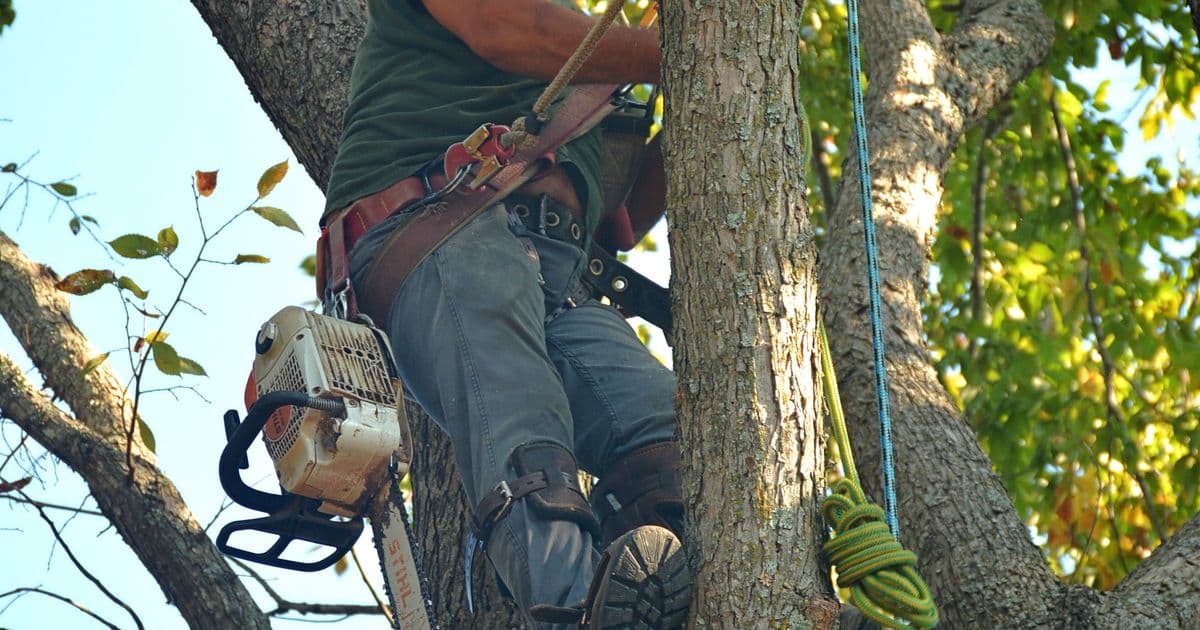
- Sixty feet up a gum tree on a climbing line with a running saw
- Operating a chipper or stump grinder at full noise
- Setting rigging to lower a heavy limb over a fence or roof
- Running a crane pick on a technical removal near power lines
- On a council or utility clearance job with no reception
- Walking a property to quote while the phone rings in the truck
Some callers leave voicemail and others try another provider. A tested backup can acknowledge the request, collect minimal administrative details, and offer an estimate or callback without claiming the site is safe or that a crew is coming. Preserve voicemail or another human fallback because carrier forwarding, telephony, software, calendars, and destinations can fail. The complete AI receptionist guide for small businesses explains the broader model, and the tree services AI receptionist page covers the published industry workflow.
How Should the AI Handle Storm Calls and Reported Hazards?
The self-serve AI must not sort a genuine hazard from a routine job. That requires professional or emergency assessment. It can state that it is an answering service, provide the tree company's pre-approved emergency limitation, and record what the caller says without endorsing the caller's diagnosis. Response time varies with the carrier, network, model, tools, and configuration.
You can configure the AI to:
- Give the approved instruction to contact the appropriate local emergency service, road authority, utility, or network operator when the caller reports immediate danger or a power-line issue
- Tell callers not to rely on the AI, an alert, or a callback request as confirmation that a site is safe or a crew has been dispatched
- Capture minimal contact, location, and caller-described context without asking anyone to approach, measure, touch, move, or inspect a tree or line
- Send a configured alert and summary, while recognising that delivery and human response are not guaranteed
- Offer routine pruning, thinning, and stump-grinding estimate slots only where the owner has approved direct calendar booking
AI answering can reduce a one-person phone bottleneck, but actual concurrency depends on numbers, carriers, routing, platform availability, configuration, and downstream staff. Do not promise unlimited calls, no hold time, or every-call capture. For more on safe fallback design, see how AI answering services handle emergency calls.
Booking Estimates Without Stopping the Job
Many tree jobs need an on-site look before a quote. The AI's appropriate role is therefore to offer an approved estimate slot or take a callback request, not diagnose the tree or quote removal. Direct booking depends on configured availability and business rules. Optional SMS confirmation is consent-dependent and separately metered, and a calendar entry is not a safety assessment or dispatch promise.
Native D2C calendar options are Cal.com (which can connect to Outlook), Google Calendar, and GoHighLevel Calendar. Keep questions to information a caller can provide safely, such as the number of trees or whether stump grinding is requested. Do not ask a caller to approach a damaged tree, estimate height beneath it, inspect a line, or verify equipment access in a hazardous area. An arborist or qualified crew confirms site conditions, safety, access, scope, and price.
If you run other tools like a CRM, Trillet can connect to them via its platform API on a do-it-yourself basis, so the calendar works automatically while deeper integrations are yours to wire up.
Handling Seasonal Spikes, Insurance, and Municipal Work
Tree-service demand may rise after storms and during seasonal maintenance periods. An AI route can help collect administrative requests during those peaks, but it does not increase field capacity or make unsafe work ready to schedule.
The AI keeps the higher-value work from slipping through:
- Insurance-related enquiries: for self-serve D2C, capture ordinary contact details and whether the caller has contacted the insurer. Do not collect policy or claim credentials, financial information, or documents through unattended intake.
- Municipal and utility enquiries: record a public organisation name, callback details, and a non-sensitive reference only if the customer has approved that field. Do not treat the AI as an authorised line-clearance dispatcher.
- Seasonal planning: compare actual voice and messaging usage during peaks and maintain a staffed response plan. The same pattern is covered in the AI receptionist for seasonal business guide.
Configured email summaries and optional SMS alerts can support review between jobs. Do not promise delivery after every call or label an alert a genuine emergency. A qualified person decides priority and response.
What It Costs and How Setup Works
Trillet's AI receptionist is $49/month including 150 voice minutes, then $0.20/minute (as of September 2026). At exactly 100 two-minute calls, voice usage is 200 minutes, so the base plan plus voice overage is $49 plus 50 × $0.20, or $59. Actual duration varies, and SMS, telephony, numbers, taxes, and other ancillary usage may add cost. The D2C plan has a 28-day plan money-back guarantee subject to the current Trillet Terms; ancillary charges are not promised refundable. See the pricing page.
Trillet can draft an initial agent from a website and owner-supplied details in about five minutes. That is not a production-ready storm or safety workflow. Review the services, area, hours, hazard limitations, emergency wording, alerts, calendar rules, and fallback, then test representative calls. Many businesses can keep their number and use call forwarding, but carrier support, activation, charges, ring timing, voicemail interaction, and reliability vary. Follow current carrier instructions and test from another phone.
Frequently Asked Questions
Can the AI tell a real tree emergency from a routine quote?
No. The self-serve receptionist must not decide whether a tree, limb, structure, road, or power line is safe or whether a caller can wait. It can deliver owner-approved wording directing a caller who reports immediate danger or a line issue to the appropriate local emergency service, road authority, utility, or network operator. An alert or callback is not emergency response or dispatch confirmation.
Will the AI quote a price for a tree removal over the phone?
It should not give a final removal quote. Pricing can depend on height, species, access, rigging, equipment, site conditions, structures, and lines. The AI can offer an approved estimate slot or callback request and gather only details the caller can provide without entering a hazardous area. A qualified person confirms the site and price.
Does it work with my existing business number?
Often. Many businesses keep their existing number and use conditional call forwarding. Carrier support, activation time, charges, ring timing, and voicemail behaviour vary. Follow current carrier instructions and test busy, no-answer, declined, unreachable, and disabled-forwarding scenarios.
Can it handle the flood of calls after a big storm?
The AI can reduce a one-person phone bottleneck, but do not promise unlimited calls, no hold time, perfect consistency, every-call capture, hazard triage, or field capacity. Test expected load, monitor routing and alert failures, preserve voicemail or another fallback, and add human response capacity when demand rises.
Will callers know it is not a person?
The agent should identify itself accurately and provide any AI or recording notice required for the workflow. Trillet supports 32 languages, but test the selected language and voice combination. Owner-reviewed website knowledge can answer approved public questions; uncertain, hazardous, or specialist questions need a human callback rather than an invented answer.