






Four Voice AI Platforms Duke It Out For The Agency Crown
This article began with a May 2025 directional test of Trillet, Bland, Retell, and Vapi. The original notes do not preserve enough information to reproduce a controlled benchmark: sample count, exact dates and routes, models, voices, carriers, timing boundary, raw results, and limitations are incomplete. Treat those observations as historical context and use the September 2026 pricing and product corrections below for current procurement.
If you prefer a visual representation here is a quick comparison chart.
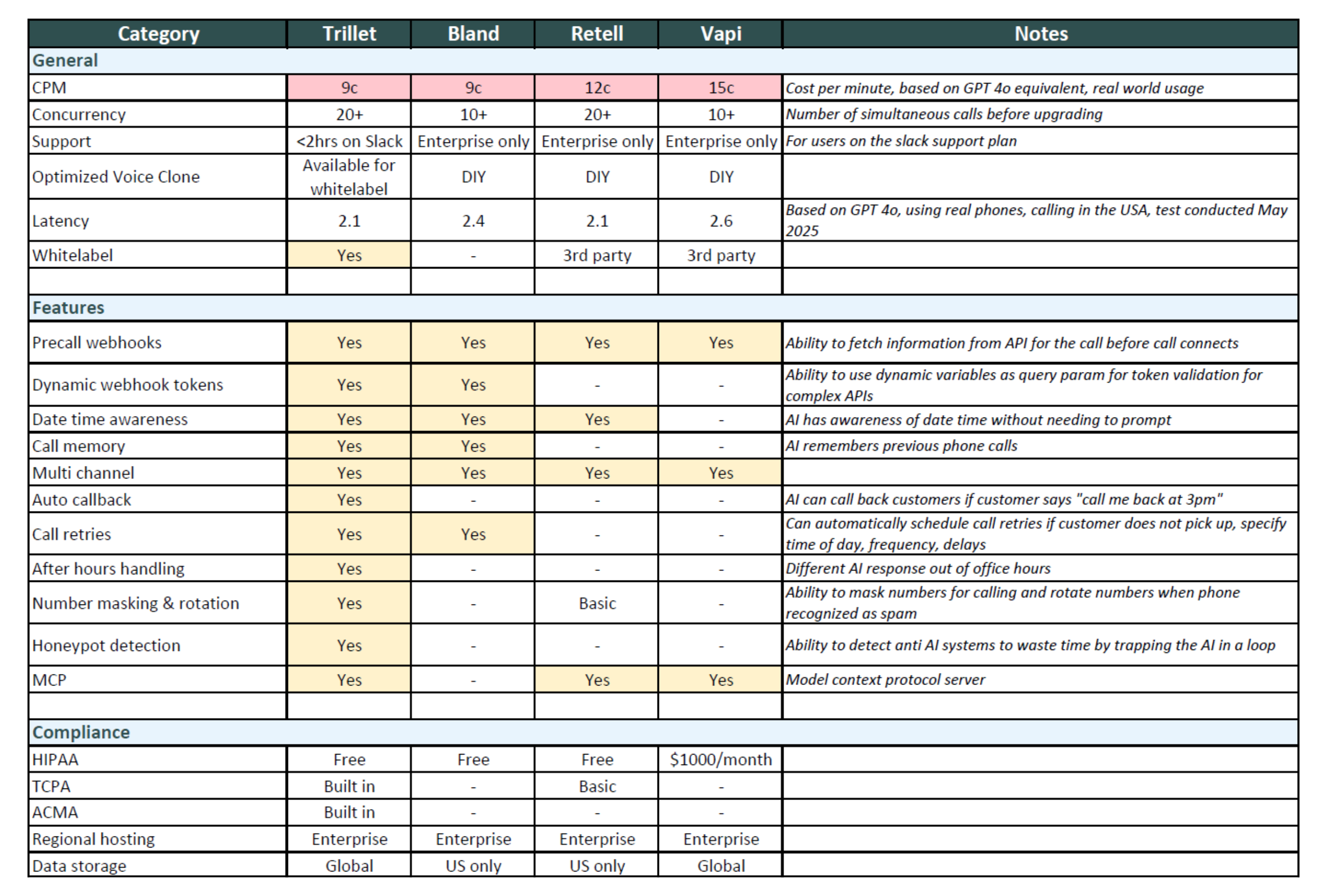 blogimage222
The contenders and testing methodology
Trillet, Bland AI, Retell AI, and Vapi represent different approaches to AI voice calling. The legacy test used broadly comparable models on US phone calls, but its result is directional rather than a reproducible head-to-head. Agencies should rerun the same scripted and unscripted calls using their intended model, voice, carrier, tools, and timing definition.
Trillet reports sub-one-second responses averaging around 400ms. It owns and operates the application, orchestration, workflow, multi-tenant, and agency layers while managing contracted speech, model, telephony, cloud, and other subprocessors. Retell, Vapi, and Bland expose different configuration choices, so compare end-to-end results in the exact deployment rather than attributing every timing difference to a “native” label.
Performance metrics that matter
Latency results favored the native stack. Trillet returned sub-1-second responses (around 400ms average), while the developer platforms clustered higher and shifted with whatever model and telephony configuration you run. That spread might seem negligible, but it impacts conversation flow and completion rates.
Pricing works differently on each platform, so a single per-minute number is misleading. Trillet Studio is $99/month with 1,000 included AI minutes; Agency is $299 with 3,000, then $0.12 per additional AI minute before telephony. After a transfer, AI usage stops and the human-call portion is $0.05 per minute. Bland Start has no fixed subscription and begins at $0.14/minute; Build is $299 plus $0.12/minute and Scale is $499 plus $0.11. Retell is component-priced from roughly $0.07 to $0.31/minute. Vapi combines its plan or hosting charge with selected model, voice, transcription, and telephony costs, so its all-in rate must be configured rather than assumed. Developer platforms can be cheaper for technical teams.
Concurrency is plan-, account-, carrier-, and contract-specific. Ask each vendor for the current included limit, burst behaviour, queueing, increase process, and hard cap, then load-test the same representative workflow before committing client capacity.
The feature matrix reveals platform priorities
Some features sound boring until you need them. Call memory, the ability to reference previous interactions within the approved data scope, should be tested on the exact plan and retention configuration. Do not infer that Retell or Vapi lacks it merely because a turnkey agency page does not advertise it.
Credential isolation and webhook authentication matter when managing multiple client integrations. Verify how each platform scopes secrets, rotates tokens, separates organizations, and records tool calls; public materials do not support a blanket claim that Retell or Vapi lacks secure webhook controls.
Auto callback functionality is built into Trillet. When prospects request callbacks, Trillet's AI actually delivers them, where the developer platforms typically leave you to build scheduling or callback logic yourself.
Honeypot detection is one of Trillet's more distinctive agency features. Honeypots are trap numbers designed to detect an AI caller and stall the call to burn through your minutes and credits. Trillet identifies and avoids or flags them automatically, protecting your outbound usage costs.
White-label capabilities define agency readiness
Agencies need to present solutions as their own. The platforms take surprisingly different approaches.
Trillet offers native white-label on two plans: Studio at $99/month includes three workspaces, 1,000 AI minutes, three phone numbers, branding on a Trillet-hosted address, 2,000 workflows, and email/ticket support. Agency at $299 includes unlimited workspaces, 3,000 AI minutes, 10 numbers, a custom domain and branded email, custom minute markup, 10,000 workflows, and priority support. Usage above the allowance is $0.12 per AI minute before telephony. White-label plans have a seven-day card-required trial; the 28-day guarantee belongs to D2C.
Bland is a first-party voice platform and offers white-label rights through Enterprise agreements. Its public materials do not establish the turnkey agency portal, custom-domain, and rebilling mechanics Trillet publishes, so compare the Enterprise contract rather than saying Bland has no white-label option.
Retell and Vapi do not publicly document a turnkey agency portal comparable to Trillet's. Their APIs and organization controls can support custom builds, while third-party wrappers offer an off-the-shelf branded layer. The wrapper fee and upstream relationship vary by vendor; low-cost options can begin around $28-$29 rather than a universal $200-$500.
Support structures and hidden costs
Support paths vary by plan and operating model. Trillet provides email/ticket support on Studio and priority support on Agency; public materials do not promise a direct line to engineering. Bland, Retell, and Vapi support their first-party platforms, while an agency using a separate wrapper may need to coordinate wrapper and upstream-provider evidence during an incident.
The math gets interesting at scale. An agency running 100,000 minutes monthly faces roughly these platform-plus-usage costs:
- Trillet: $11,939/mo before telephony (Agency $299 + 97,000 overage min x $0.12), native white-label included
- Bland: ~$11,500/mo (Scale tier $499 + ~$0.11/min), before any contract-specific Enterprise white-label terms
- Retell: $7,000-$31,000 at its published component range, before any optional wrapper
- Vapi: hosting plus the selected model, voice, transcription, telephony, and any optional wrapper; calculate the configured stack
The developer platforms can undercut Trillet on raw per-minute cost if you have engineers to build and maintain the product. Trillet's figure already bundles the finished, natively rebrandable platform, so there is no separate wrapper bill and no second vendor to reconcile.
Platform philosophies and target markets
Each platform targets a different operating model. Bland builds first-party infrastructure for technical and enterprise teams and offers contractual Enterprise white-label rights. Its public material does not establish the same turnkey agency portal, custom-domain, and rebilling package Trillet publishes, so agencies should verify those mechanics in the proposed agreement.
Retell and Vapi provide powerful APIs expecting developers to build solutions on top. Their third-party ecosystems prove this strategy works, though it adds complexity for agencies wanting turnkey solutions.
Trillet appears designed specifically for agencies running outbound campaigns. Features like honeypot detection, auto-callback, and native white-label address common agency pain points directly.
Making the choice
The "best" platform depends entirely on your use case.
For agencies running outbound campaigns, Trillet's feature set aligns perfectly with common requirements. The native white-label and unique features like honeypot detection provide immediate value.
For enterprises with development resources, Bland offers solid first-party infrastructure at competitive pricing and contract-based Enterprise white-label rights. Confirm the client-portal and resale mechanics required by the agency.
For maximum flexibility, Retell provides first-party voice infrastructure with an established ecosystem. A separate wrapper or custom portal is optional when an agency needs turnkey branding and client operations; compare that extra layer only if the deployment actually uses one.
For custom implementations, Vapi's API-first approach enables unique solutions. Its Core plan starts at $29/month, while the complete call cost adds hosting and provider components. It can be cost-effective for technical teams, with engineering and agency-layer work included in the comparison.
The market evolution continues
The AI voice platform space remains remarkably dynamic. Established players like Vapi and Bland attracted significant venture funding. Vapi raised a $50 million Series B in 2026 at roughly a $500 million post-money valuation (about $72 million total), while Bland has raised $100 million or more in total across its Series B and Series C. This capital enables continued innovation but also locks in certain strategic decisions.
Meanwhile, newer entrants like Trillet can learn from others' mistakes. By studying what agencies actually struggle with, honeypot calls, callback management, white-label complexity, they've built targeted solutions rather than generic platforms.
The bottom line
For agencies starting their AI voice journey, the decision often comes down to build versus buy. Platforms like Retell and Vapi offer powerful tools for custom solutions. Bland provides enterprise-grade infrastructure and contract-based white-label rights, with the exact agency mechanics to be verified.
Trillet takes a different approach: providing a complete white-label platform for agencies optimized for common agency use cases across inbound reception, outbound calling, and campaign work. The included features eliminate development time, the native white-label preserves agency relationships, and the transparent per-minute pricing enables profitable scaling.
The market has room for all approaches. Some enterprise teams value Bland's infrastructure, developers may prefer Vapi or Retell flexibility, and agencies may prefer a purpose-built operating layer. The right choice depends on client workflow, delivery capability, contract terms, support boundaries, and total cost.
As AI voice technology matures, expect further specialisation. Agencies should choose from current evidence rather than assuming one architecture wins every use case.
Frequently Asked Questions
Which platform is best for a non-technical agency?
A finished agency operating layer can reduce build and vendor-coordination work, but test branding, workspace isolation, billing, support, call quality, and integrations in the plan you will actually buy. Trillet packages those agency functions directly; developer platforms can fit teams prepared to build or contract for them.
Do Bland, Retell, or Vapi support white-label agency delivery?
Bland offers contract-based Enterprise white-label rights. Retell and Vapi provide first-party infrastructure that agencies can place behind a custom application or a separately contracted wrapper, but their public sites do not establish a turnkey agency portal equivalent to Trillet's package. Verify the exact rights and workflow in writing.
Can this article's May 2025 latency observations be treated as a current benchmark?
No. The surviving methodology is insufficient for reproduction, and platform configurations have changed. Run a new controlled test using the intended model, voice, carrier, tools, locations, sample size, and timing definition.
Updated for September 2026: aligned Trillet allowances, trial, transfers, and support; corrected Bland's Enterprise white-label path; qualified Retell/Vapi agency options and feature claims; and recomputed the 100,000-minute comparison.
Related Resources
- White-Label Voice AI Platform Guide for Agencies
- How to Start a White-Label Voice AI Agency (2026)
- Best White-Label Voice AI Platform 2026: How to Choose (and Top 10)
- Comparing No-Code Phone Agents for Outbound Calling in 2026
- Trillet vs Retell vs Vapi for Agencies: Which Voice AI Platform Wins in 2026?